Member experience now drives the rating, but “improve member experience” is not an operational directive. The useful question is more specific: which specific survey measures does the member services operation actually move, and what moves them?
This post maps the call center to the measures it controls on both the Medicare and ACA sides, so an operations or quality leader can point to a line on the survey and name the lever behind it.
Key Takeaways
- “Improve member experience” is not an operational instruction. The useful question is which specific survey measures the call center moves, and what moves them.
- On the Medicare side, the call center most directly drives Customer Service, Getting Needed Care, Getting Appointments Quickly, and Rating of Health Plan, plus the complaints that count separately.
- The ACA QHP Enrollee Survey asks parallel questions, and that result is shown to shoppers during open enrollment, so the call center shapes acquisition as well as retention.
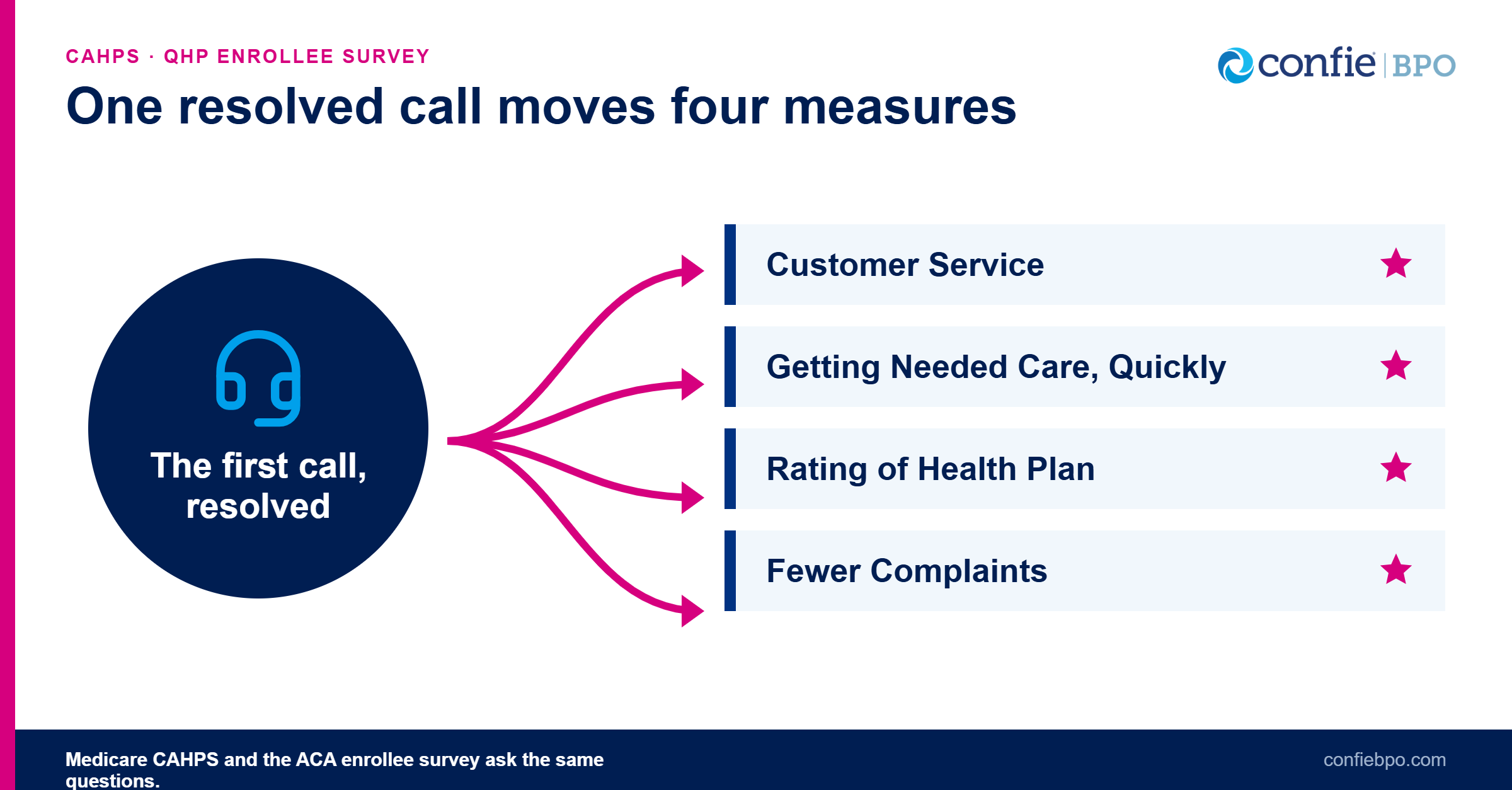
- First-call resolution is the single highest-leverage lever. It moves four survey measures at once and suppresses the complaints that count on their own.
- CAHPS and HOS are projected to reach nearly 40 percent of Star weight by 2029, putting the contact center near the center of the rating.
- Manage leading indicators weekly (first-call resolution, speed of answer and abandonment, transfer rate, complaint volume) rather than waiting for the March survey verdict.
Why This Is Worth Mapping Now
Member experience is increasingly important in the Medicare Star Ratings as administrative measures are removed, with CAHPS and HOS projected to account for nearly 40 percent of the total weight by 2029 (Press Ganey, 2026). On the ACA side, the Quality Rating System (QRS) rates qualified health plans across three domains, Medical Care, Member Experience, and Plan Administration, with the Member Experience domain drawing on the CAHPS-based QHP Enrollee Survey, which is displayed to shoppers during open enrollment (Centers for Medicare & Medicaid Services, 2026).
Both systems quantify how members feel about receiving care and help. A large share of that number is set in the contact center. The problem most plans face is that the survey arrives as a single, lagging verdict, long after the calls that shaped it. Mapping the call center to the specific measures it touches is how a leader turns a vague mandate to lift experience into a short list of things to manage week to week.
The Medicare CAHPS Measures the Call Center Touches
Not every Star measure goes through member services, but several experience measures do. Each one below is worth understanding on its own terms because the lever behind it is different.
Customer Service
The most direct line of all. This measure reflects whether members received courteous, helpful, and timely assistance when they called, how easy it was to get the information they needed, and how well the plan handled their requests. It is, in effect, the contact center expressed as a single survey score. Nothing a plan does moves this measure more than the quality and consistency of the people answering the phone.
Getting Needed Care and Getting Appointments Quickly
These access measures are shaped by how quickly and completely the team resolves access questions, referrals, and authorizations, rather than bouncing the member between queues. A member who calls about a referral and gets a clear answer on the first try experiences getting needed care quickly. A member who is transferred three times and calls back twice does not, regardless of the clinical network’s configuration.
Rating of Health Plan
An overall judgment is that a frustrating, unresolved call drags down, while a clean first-call resolution lifts. Members do not separate their feelings about the plan from their last interaction with it. For most members, most of the time, the call center is the plan they actually experience.
Complaints and Appeals Handling
Unresolved issues become logged CMS complaints, which count against the rating on their own, separate from the survey. A complaint is often a service failure that the operation could have prevented during an earlier call. Handling the issue well the first time is both a service win and a complaint avoided.
The ACA QRS Measures the Call Center Touches
The QHP Enrollee Survey, which feeds the QRS Member Experience domain, asks parallel questions: how easy it was to get care, how well the plan’s customer service helped, and the member’s overall rating of the plan. The same contact-center behaviors that drive Medicare CAHPS scores also drive these measures, and the results are visible to shoppers at the moment they choose a plan. For a marketplace plan, the call center shapes not only retention and ratings but also the number of prospective members a member sees before they ever enroll.
What Actually Moves These Measures
The measures above address a short list of operational levers within the member services function’s purview.
- First-call resolution. The single most influential lever. A resolved first call lifts Customer Service, Rating of Health Plan, and Getting Needed Care at once, and prevents the repeat contact that breeds complaints.
- Wait times and abandonment. Long holds and dropped calls are perceived as poor service, pushing members to give up, then complain or leave.
- Consistency across the season. A team that resets every fall delivers uneven service precisely when surveys are conducted. Continuity ensures a stable experience throughout the survey window.
- In-language quality. For plans with significant Hispanic membership, whether a member is genuinely understood, not just answered in Spanish, moves the average where it most often drags it.
The Leading Indicators Behind the Lagging Measures
For the leader who runs the operation day-to-day, the map’s practical value is that it turns a lagging score into leading indicators you can manage now. The survey is a verdict delivered in March on calls that happened months earlier. By the time the rating posts, the calls that set it are long past. The operational metrics that feed those measures, however, are visible in real time.
First-call resolution is the closest leading indicator of Customer Service and Rating of Health Plan. Average answer speed and abandonment rate are leading indicators of the access and getting-care-quickly measures, because a member who could not get through did not receive timely help by any definition. Transfer rate is an early warning for both, since every transfer gives the member a chance to repeat their story and lose confidence. Complaint volume is a leading indicator of its status as a Star measure and a downstream signal of upstream first-call resolution problems. A weekly dashboard of those four, read against targets, tells a quality leader where the March survey is heading while there is still time to change it.
A Worked Example
Consider what a single operational move does across the map. Suppose a plan lifts first-call resolution from 70 percent to 80 percent over the course of a season. That ten-point move is not a single improvement; it is several at once. Fewer members leave the first call unresolved, so Customer Service and Health Plan Rating rise. Fewer members call back, so repeat-contact volume and the complaints that stem from it decline. Fewer unresolved access questions mean the getting-needed-care measures improve. One lever, pulled consistently, moves four survey measures and reduces the complaint count that is counted separately. That is why first-call resolution, not handle time, is the metric a rating-focused operation manages to.
What a Generic Vendor’s Metrics Miss
This is where the choice of operating partner matters more than it seems. A generic, high-volume contact center is measured, and often paid, on the metrics that lower its own costs: average handle time, calls per hour, cost per interaction. None of those metrics moves your rating, and the most prized of them, short handle time, can actively work against first-call resolution, because the fastest way to end a call is rarely the way that resolves it. A partner optimized for throughput is optimized for the wrong number.
Offshore distance compounds the gap in exactly the measures that now carry the rating. A queue many time zones from the member strains to cover U.S. business hours, and a Spanish line staffed without cultural fluency answers the words but not the worry, which shows up directly in the survey average for plans with significant Hispanic membership. Rigid service-level agreements built around speed, not resolution, measure the wrong thing well. When the rating is built on whether members felt helped, a vendor whose scorecard never mentions resolution or experience is reporting on a different business than the one you are trying to run.
How to Hold the Operation Accountable
Once the map is clear, the management job follows. Track first-call resolution, wait and abandonment, and complaint volume as leading indicators of the survey measures they feed, rather than waiting for the rating to tell you a year later. Whether member services is in-house or outsourced, build those measures into how the function is reviewed, with shared definitions so both sides read the same numbers and a regular cadence that catches service drift before it reaches a member and a survey.
For a chief operating officer or customer-experience leader, that reframes the relationship with a partner. The right arrangement reports on the measures that move the rating, not just speed and volume. It agrees on definitions up front so first-call resolution means the same thing to both sides. It runs on a governance cadence frequent enough to act within the season. And it treats the member journey as a single relationship across enrollment, onboarding, and the first-quarter save call, because the survey scores the whole journey, not any single interaction.
In-Language Quality as a Measure Mover
Among all the levers, in-language quality is the one most often left out of the measurement conversation, and for plans with significant Hispanic membership, it is frequently the one that moves the average the most. The mechanism is simple arithmetic. The survey does not separate language groups; it averages them into a single rating. If a large share of members are served in their second language by agents who answer correctly but lack cultural fluency, those members rate the plan lower on Customer Service and overall plan rating, and that lower experience is folded into the single number CMS publishes. A plan can run strong English-language metrics and still post a mediocre rating because a meaningful slice of the book is quietly underserved. Measuring in-language first-call resolution and satisfaction separately, then closing the gap, is how a plan finds the points hiding in plain sight.
Onboarding and the Measures It Protects
The measures move not only during complaints and save calls but also during onboarding, in the first weeks after a member’s coverage begins. A new member navigating a first claim, a new ID card, or a first prior authorization is forming an impression that will become a survey answer in March. Handle those early interactions well, and the member starts the relationship trusting the plan, which lifts the overall plan rating and reduces the complaints that would otherwise accrue. Handle them poorly, and the plan has manufactured a detractor before the member has had a single clinical encounter. Onboarding is, in measure terms, where a plan either builds a buffer or digs a hole, and it happens in the same first quarter that the survey will remember.
Why Continuity Shows Up in the Score
Consistency deserves its own line because it is easy to undervalue. The survey rewards not just good calls but uniformly good calls, and a team that resets every fall delivers its least consistent service exactly when the survey window is open. A returning, plan-fluent professional handles the February formulary call the same way they handled the October enrollment call, and the member experiences one plan, not a lottery of agents at different points on a learning curve. The measures capture that steadiness. A plan that rebuilds its operations every season is, in effect, reintroducing variance into the very months CMS measures, which is the opposite of what the rating rewards.
A Lever-to-Measure Map
It helps to hold the whole picture in one view. First-call resolution moves Customer Service, Rating of Health Plan, and the getting-needed-care measures, and suppresses complaints. Speed of answer and abandonment move the access and getting-care-quickly measures. Transfer rate moves Customer Service and, indirectly, complaints. Consistency across the season protects all of the above through the survey window. In-language quality moves the average share of the book served in a second language. Complaint handling moves the complaint measure directly and protects the overall rating. Read top to bottom, the map says the same thing in every row: the member services operation is not adjacent to the rating; it is one of its primary inputs, and the levers that move it are the ones a quality leader can manage week to week.
What This Means for an Outsourced Operation
For a plan that outsources member services, the map also serves as a specification. A partner should be able to report on each of these levers, not just handle time and service level, and the definitions should align with yours so that first-call resolution means the same thing on both sides. The partner should manage the levers that move the rating rather than those that lower its own cost, and it should show in-language metrics separately so that the gap that drags down the average does not hide in a blended number. A partner that can only report speed and volume is measuring a different business than the one the rating grades. A partner that reports on resolution, complaints, consistency, and in-language quality is one whose dashboard matches the rating you are trying to protect.
Start With One Measure
A plan does not have to overhaul its operations to act on this. The fastest progress usually comes from picking one measure the call center can clearly move, with first-call resolution a common choice, and managing it deliberately for a season. Define it precisely, baseline it honestly, set a target, and review it weekly with whoever runs the floor, whether in-house or outsourced. Because first-call resolution feeds several survey measures at once, a disciplined push on that single number tends to lift Customer Service, the overall plan rating, and the access measures together, while suppressing complaints that arise from unresolved calls. Once the team has proven it can move one measure, the same discipline applies to the next. The new math rewards action that starts now, on a metric the operation can control, rather than a grand initiative that waits until next year’s planning cycle. The rating is built one measure and one resolved call at a time.
Three Recommendations for a Rating-Focused Operation
- Build a lever-to-measure dashboard and manage four leading indicators each week during the season (first-call resolution, speed of answer and abandonment, transfer rate, and complaint volume) so you can see where the March survey is heading while there is still time to change it.
- Make first-call resolution, not handle time, the primary metric for the member services operation, and include it in any partner scorecard with a shared definition, because resolution is the single lever that moves the most survey measures at once.
- For any plan with significant Hispanic membership, measure in-language first-call resolution and satisfaction separately from the blended numbers, then close the gap, because that is where the survey average most often drags down without ever showing up in English-language metrics.
Know which measures your call center is moving.
Watch the On-Demand Session
Our webinar, Member Services Experience Across Medicare and ACA: How Member Services Performance Decides Future Revenue, maps contact-center performance to CAHPS, the ACA Quality Rating, complaints, and disenrollment, and what to hold the operation accountable for.
A Note on the Operating Model
ConfieBPO structures member services around the experience measures that drive ratings, with shared KPIs and full visibility, an approach refined for insurance and regulated industries since 1998. The principle holds regardless of provider: the rating is built one resolved call at a time, and the measures that matter are the ones the call center touches every day.
Frequently Asked Questions
- Which CAHPS measures are most affected by the call center?
The call center most directly affects Customer Service, Getting Needed Care, Getting Appointments Quickly, and Rating of Health Plan. Unresolved issues also become logged CMS complaints, which count against the rating separately from the survey. In effect, the contact center is the plan most members actually experience, so its quality sets these scores.
- Does the same apply to ACA plans?
Yes. The QHP Enrollee Survey, which feeds the ACA Quality Rating System, asks parallel questions about access, customer service, and overall plan rating (Centers for Medicare & Medicaid Services, 2026). The same contact-center behaviors drive both systems, and because the ACA result is shown to shoppers during open enrollment, the call center shapes acquisition as well.
- What single lever moves the most measures?
First-call resolution moves the most. A resolved first call lifts Customer Service, Rating of Health Plan, and the getting-needed-care measures at once, while preventing repeat contacts that generate complaints. One lever pulled consistently moves four survey measures and reduces the separately counted complaint volume, which is why it outranks handle time.
- What leading indicators should we track?
Track four leading indicators: first-call resolution, average speed of answer and abandonment, transfer rate, and complaint volume. These indicators move before the survey, so a weekly read tells you where the March rating is heading while there is still time to act. The survey itself is only a lagging verdict on calls already closed.
- Why does the first quarter matter so much?
The first quarter matters because CAHPS surveys reach members in March, so the experience members carry into that survey sets next year’s rating (Press Ganey, 2026). The same months also see the heaviest switching and complaint volume, which means the calls that shape the score and those that decide retention arrive together.
- Why can a low-cost vendor still hurt the rating?
A low-cost vendor can hurt the rating because it optimizes for handle time, calls per hour, and cost per interaction, none of which is the rating. Short handle time can actively work against first-call resolution, the lever that moves the score, because the fastest way to end a call is rarely the way that resolves it.
- How should we measure the call center against these ratings?
Track first-call resolution, wait and abandonment, and complaint volume as leading indicators of the survey measures they feed, rather than waiting for the rating a year later. Use shared definitions so both sides read the same numbers, and a regular review cadence, whether the operation is in-house or outsourced, that is frequent enough to act within the season.
- Why is member experience a growing share of the rating?
Member experience is growing as CMS removes high-performing administrative measures, leaving the remaining experience measures to carry a greater share of the total weight. CAHPS and HOS are projected to account for nearly 40 percent of Star weight by 2029 (Press Ganey, 2026), which places the contact center near the center of the rating.
- Does in-language service affect these measures?
Yes. For plans with significant Hispanic membership, whether members are genuinely understood, not merely answered in Spanish, affects the survey average because the rating does not separate language groups; it blends them into one number. A book served correctly but without cultural fluency rates the plan lower, quietly dragging the published score down.
- Where should a plan start?
Start with one measure the call center can clearly move, usually first-call resolution. Define it precisely, baseline it honestly, set a target, and review it weekly with whoever runs the floor. Because it feeds several survey measures at once, a disciplined push on that single number lifts multiple rating inputs together while suppressing complaints.
References
- Centers for Medicare & Medicaid Services. (2026). Health insurance marketplace quality initiatives. https://www.cms.gov/marketplace/about/health-insurance-marketplace-quality-initiatives
- Press Ganey. (2026). Are you ready? CMS just ignited the biggest Stars shake-up in a decade. https://www.pressganey.com/resources/blog/cms-stars-shake-up/