A bilingual representative can translate the words. A bicultural representative understands what the words mean to the member. On a retention call, that difference often determines whether the member stays or leaves.
Plans often treat language access as a checkbox: hire enough Spanish-speaking agents, and the requirement is met. That solves translation. It does not solve the harder problem, which is building trust at the moment a member decides whether to walk.
This post explains the difference between bilingual and bicultural service, how it changes the call, and why it matters most during the first-quarter retention window.
Key Takeaways
- Bilingual service translates the words. Bicultural service understands what the words mean to the member, and on a retention call, that difference often decides whether the member stays.
- A separate Spanish-language queue solves translation, not trust. It gates cultural fluency behind a transfer on the exact calls where added friction drives members away.
- Member experience is an increasing share of the Medicare Star Ratings, and CAHPS surveys reach members in the first quarter, the same window as Medicare OEP (January 1 to March 31).
- For a Hispanic-heavy book, bicultural service is the lever that most directly affects the survey average because the rating aggregates all language groups into a single number.
- The most costly failure is silent churn: members who feel misunderstood leave at open enrollment without ever filing a complaint.
- Bicultural capability is a hiring and team-design decision, best embedded across every role and channel rather than being siloed in a single queue.
Bilingual and Bicultural Customer Service Are Not the Same Thing
Bilingual means a person can conduct a conversation in two languages. It is necessary, and for many members it is the baseline for being served at all.
Bicultural means the person also understands the cultural context behind the conversation: the family dynamics surrounding a healthcare decision, the weight of a relationship with a trusted doctor, and the pace and tone a conversation needs to be respectful rather than transactional.
What Changes on the Retention Call
On a routine question, the gap is small. On a retention call, it is decisive because the member is not just asking for information. They are deciding whether this plan understands them.
- The family dynamic. Many coverage decisions are made for a spouse, parent, or adult child, or on their behalf. A bicultural professional recognizes who is truly in the conversation.
- The doctor-patient relationship. Losing access to a long-trusted physician carries cultural and emotional weight that a script cannot capture.
- Pacing and tone. The same words, delivered at the wrong pace or in the wrong register, can read as dismissive and, on a save call, end the relationship.
- Trust on the first call. A member who feels understood is willing to let the professional solve the problem rather than hanging up and shopping for other plans.
Why a Spanish-Language Queue Is Not Bicultural Service
The most common way plans get this wrong is to stand up a separate Spanish-language queue and consider the need met. It is a structural answer to a human problem, and it underperforms in two predictable ways. First, it gates cultural fluency behind a transfer, so a member reaches it only after explaining their problem once to someone who could not fully help, which is itself a frustration on a call where frustration is the risk. Second, a queue staffed for language alone, common in offshore and generalist models, answers in Spanish without the lived cultural context that makes the answer land. The words are right, but the member still does not feel understood.
This is where an offshore or general-purpose vendor is structurally disadvantaged when serving the very members, a plan can least afford to lose. Distance, time zones, and a workforce without shared experience produce service that is technically compliant yet emotionally hollow. The reverse is also a competitive risk that never shows up cleanly in a report. A member who repeatedly feels misunderstood does not always file a complaint; sometimes they simply leave at the next open enrollment, and the plan never learns why. Bicultural service, embedded rather than siloed, reduces that silent churn.
Why Bicultural Service Matters Most for Hispanic Member Books
For plans with significant Hispanic membership, member-experience scores can hinge on whether service feels authentic rather than merely being available in Spanish. The difference shows up in survey results and retention. Bicultural capability works best when embedded across every role, so a member reaches it on the first call rather than after a transfer.
The math is unforgiving here because the rating does not separate language groups. It averages them. If a large share of the book receives service that answers the words but not the worry, that experience pulls the single rating down, and the rating drives the revenue. For a Hispanic-heavy plan, bicultural service is not a courtesy or a compliance line. It is the lever that most directly moves the survey average.
The Connection to Star Ratings and Retention
Member experience is an increasingly large share of the Medicare Star Ratings as administrative measures are removed and CAHPS surveys reach members in March (Press Ganey, 2026). The ACA Quality Rating System is likewise built in part on a CAHPS-based enrollee survey administered to shoppers during open enrollment (Centers for Medicare & Medicaid Services, 2026).
Because the Medicare Advantage OEP runs from January 1 to March 31, the first quarter serves as both the retention and survey window (Centers for Medicare & Medicaid Services, 2026). The bicultural retention call protects both the member and the rating.
A Retention Call, Two Ways
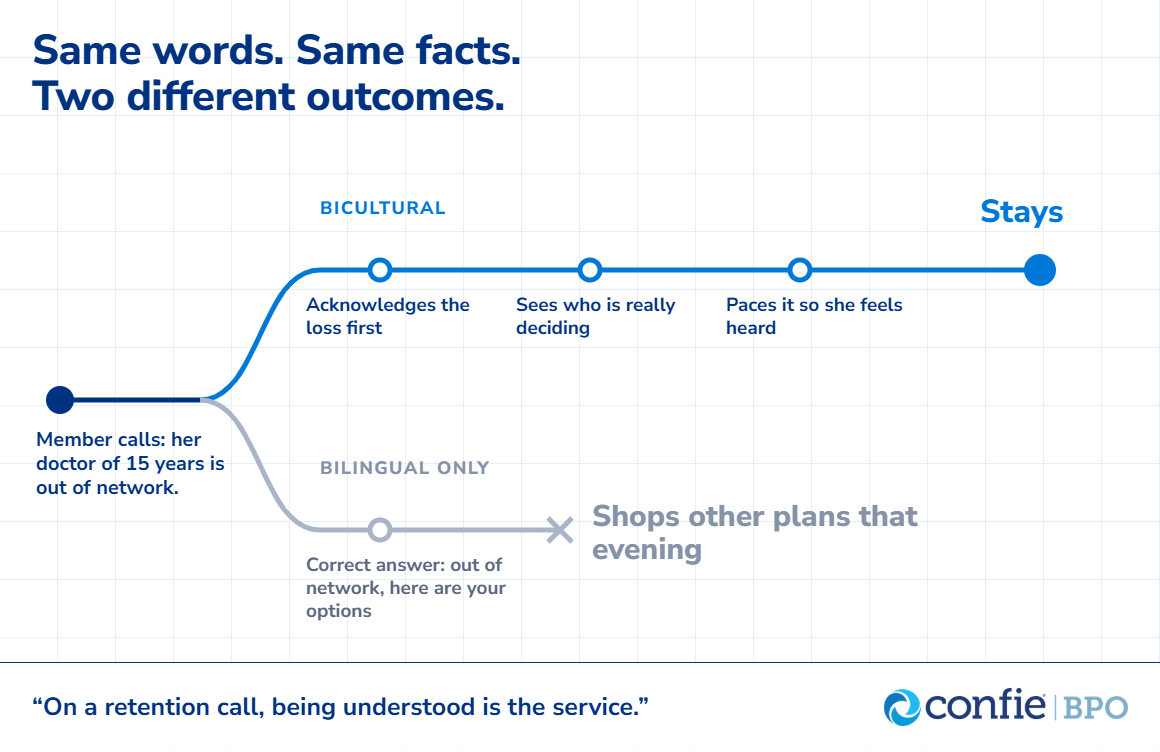
Picture the same call handled two ways. A member calls in January, upset that their primary care doctor, whom they have seen for 15 years, is no longer in-network.
A bilingual-only response answers correctly: the doctor is out of network, and here are the in-network options. It is accurate, fast, and likely to end with the member shopping for other plans that evening.
A bicultural response recognizes what that doctor relationship means, acknowledges the loss before pivoting to solutions, and paces the conversation so the member feels heard rather than processed. Same facts, very different outcome. The difference is not effort or politeness. It is understanding the meaning behind the member’s reaction and responding to that, not just to the literal question.
None of this implies that bilingual service is unimportant. Language access is the floor, the baseline for serving a member at all. Bicultural service sits on top of it, and on the calls, it is the part that actually changes the outcome.
Why Bicultural Service Is a Hiring Decision, Not a Line Item
Plans sometimes assume that a strong script and empathy training will be enough. Those help, but they cannot replicate lived experience. A professional who has navigated a healthcare decision for an aging parent, or who understands the role family plays in these choices, brings something a script cannot supply. That is the distinction between teaching words and drawing on understanding.
This is why bicultural capability is best treated as a hiring and team-design decision, not merely a training module bolted onto an existing queue. It is also why it is hard to copy. A vendor can train any agent to read a Spanish script; it cannot quickly assemble a workforce with genuine shared experience. For the leader weighing cost, the silent-churn math reframes this from a soft benefit into a financial one. Members lost to feeling misunderstood are lost without a logged reason, so they never appear in complaint reports, only in next year’s enrollment numbers and survey scores. The capability that prevents that loss is a hiring strategy, and it compounds over time as the team’s understanding of the membership deepens.
Cultural Fit Across the Journey and the Channels
The retention call is where the difference is most visible, but bicultural service matters everywhere. The same understanding shapes the enrollment call, the onboarding call, and every routine interaction in between. A member who feels understood from the first contact arrives at a retention moment already trusting the plan. The save call is easier because the relationship was built earlier, through dozens of smaller, well-handled conversations.
That is true across channels and across the calendar. Member service increasingly spans secure messaging, chat, and the plan portal, and cultural fit has to carry across all of them, not just the phone. For the leader who owns the member experience, the point is that bicultural capability works best when embedded across the whole team, the whole season, and the whole journey, rather than reserved for the hardest calls. By the time a call is hard, the trust either exists or it does not, and it cannot be created in the moment. The value is cumulative: a plan that staffs for cultural fluency throughout is not just improving individual calls; it is building a body of member goodwill that shows up in survey scores and in the members who simply never call a competitor.
Coaching the Save Conversation
Bicultural capability is most valuable on the save call, and the save call is coachable in ways a generic empathy module is not. The strongest operations train specifically on the highest-stakes conversations: how to acknowledge the loss of a trusted doctor before pivoting to options, how to identify who is really making the decision in a family, and how to pace a conversation so a frightened member feels heard rather than processed. That coaching only works on a foundation of lived experience, which is why it pairs with a hiring strategy rather than replacing it. A professional who understands the cultural weight of the decision can be coached to handle it with skill. An agent reading a translated script cannot be coached into an understanding they do not have.
Why Nearshore Fits Bicultural Service
Where the team sits determines whether bicultural service is real or nominal. A nearshore, U.S.-aligned workforce, composed of professionals who have lived in the United States and have family here, brings a genuine shared cultural context to the call and operates during U.S. business hours so members reach that service when they call. An offshore, language-only queue offers translation across time zones and cultural gaps, which is exactly the distance that turns a save call into a lost member. For the leader choosing how to staff the hardest calls of the year, proximity and shared experience are not soft attributes. They are the operational difference between service that connects and service that merely complies.
The Enrollment Call Sets Up the Save Call
By the time a member is on a save call, the outcome is largely predetermined by every call that came before. A member who was welcomed warmly in October, onboarded smoothly in January, and treated with cultural understanding throughout arrives at a February formulary problem already trusting the plan to help. A member who has felt processed at every prior touch arrives looking for a reason to leave, and a formulary change is reason enough. This is why bicultural capability cannot be reserved for the save call alone. The trust that wins the save is built earlier, in the routine conversations that a language-only model treats as transactional. The plan that staffs cultural fluency across the whole journey is not improving one call. It is changing the starting position of every save call it will ever make.
Embedded, Not Siloed: The Operating Principle
The single most important design choice is to embed bicultural professionals across all roles rather than isolate them in a separate queue. A siloed queue forces a member to first reach someone who cannot fully help, explain the problem, and then be transferred, adding friction to a call where friction is the risk. Embedding means the greeter, the inbound professional, the onboarding specialist, and the retention specialist each carry cultural fluency, so the member reaches it on the first contact, every time, in whatever channel they started. For a Hispanic-heavy plan, that first-contact fluency is what protects both first-call resolution and the survey average. The queue model treats culture as a destination. The embedded model treats it as a property of the whole team, which is the only version that moves the rating.
The Cost of Silent Churn
The most expensive failure of language-only service is the one that never generates a complaint. A member who feels repeatedly misunderstood rarely escalates. They quietly decide that this plan does not get them and leave at the next open enrollment without ever telling the plan why. That silent churn does not appear in a complaint log or a quality score; it appears only in next year’s enrollment numbers and in a survey average that drifted down for reasons the operations team cannot trace. Put a number on it: on a Hispanic-heavy book of 50,000, even a couple of points of avoidable churn driven by service that did not connect is a thousand members and a seven-figure annual revenue loss, none of it flagged in time to fix. Bicultural service is the cheapest insurance against the churn a plan cannot see coming.
Measuring What You Cannot See
The hardest part of the bicultural case is that its biggest payoff is a loss that never happens. A retained member who would otherwise have churned silently does not appear as a win in any report; they simply remain enrolled. That makes the capability easy to underfund, because the savings are invisible while the cost appears on the invoice. The way to make it visible is to measure the right things: in-language first-call resolution and satisfaction, tracked separately from the blended numbers; retention rates for the Spanish-speaking segment compared with the rest of the book; and survey results broken out by language where the data allows. When a plan measures the gap, it usually finds one, and the size of that gap is the size of the opportunity bicultural service addresses. What gets measured separately stops hiding inside the average.
How to Evaluate a Partner’s Bicultural Capability
Because the capability is a hiring decision, it is also something a plan can evaluate before signing. A few questions can distinguish genuine bicultural service from a Spanish queue with a different label.
- Lived experience, not just language. Ask how staff understand the cultural context, not just which languages they speak. Workforce background matters.
- Embedded, not siloed. Confirm that bicultural service is available across roles and on the first call, not behind a transfer that itself causes frustration.
- Coaching for the hard calls. Look for training focused on retention and save conversations, where the difference matters most.
- Aligned and close. A nearshore, U.S.-aligned workforce with a shared cultural context will outperform a distant queue staffed solely for language on the calls that determine retention.
On a retention call, being understood is the service.
Watch the On-Demand Session
Our webinar, OEP Retention: The Member Services Strategy That Keeps Members Enrolled, covers the first-quarter retention math, the highest-risk calls, and the continuity model behind them.
A Note on How This Model Is Built
On a retention call, cultural understanding is the difference between keeping a member and losing one. ConfieBPO’s teams, based in Tijuana and Mexico City and staffed by bicultural professionals, have served the insurance industry since 1998. 83% have lived in the United States, and 76% have family here.
Frequently Asked Questions
- What is the difference between bilingual and bicultural customer service?
Bilingual service conducts the call in two languages. Bicultural service goes further: it understands the cultural context behind the conversation, including family dynamics, the weight of a trusted-doctor relationship, and the pace and tone a member needs. On emotional, high-stakes calls, that understanding is what changes the outcome.
- Why does bicultural service matter most on retention calls?
Retention calls are emotional decisions made during change, such as losing a doctor or a benefit. A member who feels understood is far more likely to stay and let the representative resolve the issue rather than hang up and shop for other plans that same evening. Bicultural fluency is what builds that trust.
- Should bicultural staff sit in a separate Spanish-language queue?
No. A separate queue gates cultural fluency behind a transfer, so the member first reaches someone who cannot fully help. Embedding bicultural professionals across every role works better because the member reaches culturally fluent service on the first call, rather than after a transfer that adds frustration.
- Why does an offshore Spanish-language queue underperform?
Distance, time zones, and a workforce without a shared cultural experience tend to produce service that is technically correct but emotionally hollow. On the exact calls where feeling understood determines whether a member stays, that gap costs retention. A queue staffed for language alone answers the words but not the worry.
- How does bicultural service affect Medicare Star Ratings and ACA Quality Ratings?
Member experience is an increasingly significant share of the Medicare Star Ratings as administrative measures are removed (Press Ganey, 2026), and the ACA Quality Rating System draws on a CAHPS-based enrollee survey (Centers for Medicare & Medicaid Services, 2026). Bicultural service elevates the experience that feeds both surveys, directly influencing the rating.
- Does bicultural service apply to ACA plans as well as Medicare?
Yes. The ACA Quality Rating System rewards member experience through a CAHPS-based enrollee survey administered during open enrollment (Centers for Medicare & Medicaid Services, 2026). The same cultural understanding that protects Medicare retention also improves ACA survey results and keeps shoppers enrolled, because the experience driving both ratings is fundamentally the same.
- How can a plan evaluate a partner’s bicultural capability?
Ask about lived experience, not language alone: how staff understand cultural context and what their workforce background is. Confirm that capability is embedded across roles rather than being transferred. Look for coaching focused on retention and save calls, and favor a U.S.-aligned, nearshore workforce with a genuine shared cultural context.
- Is bicultural service only relevant on retention calls?
No. It shapes the enrollment call, the onboarding call, and every routine interaction in between. Members who feel understood from the first contact arrive at retention moments already trusting the plan, making the save call far easier. The trust that wins a save is built earlier, in dozens of smaller conversations.
- Can training alone create bicultural service?
No. Strong scripts and empathy training help, but they cannot replicate lived cultural experience. Bicultural capability is primarily a hiring and team-design decision, which coaching then sharpens. A representative who understands the cultural weight of a healthcare decision can be coached to handle it well; an agent reading a translated script cannot.
- What is the single biggest mistake plans make here?
Treating Spanish-language service as a checkbox by standing up a separate queue is a structural answer to a human problem. The fix is to embed genuinely bicultural professionals across every role, so members achieve cultural understanding on the first call, in every channel, rather than only after a transfer.
References
- Centers for Medicare & Medicaid Services. (2026). Health insurance marketplace quality initiatives. https://www.cms.gov/marketplace/about/health-insurance-marketplace-quality-initiatives
- Centers for Medicare & Medicaid Services. (2026). Open enrollment. Medicare. https://www.medicare.gov/health-drug-plans/open-enrollment
- Press Ganey. (2026). Are you ready? CMS just ignited the biggest Stars shake-up in a decade. https://www.pressganey.com/resources/blog/cms-stars-shake-up/