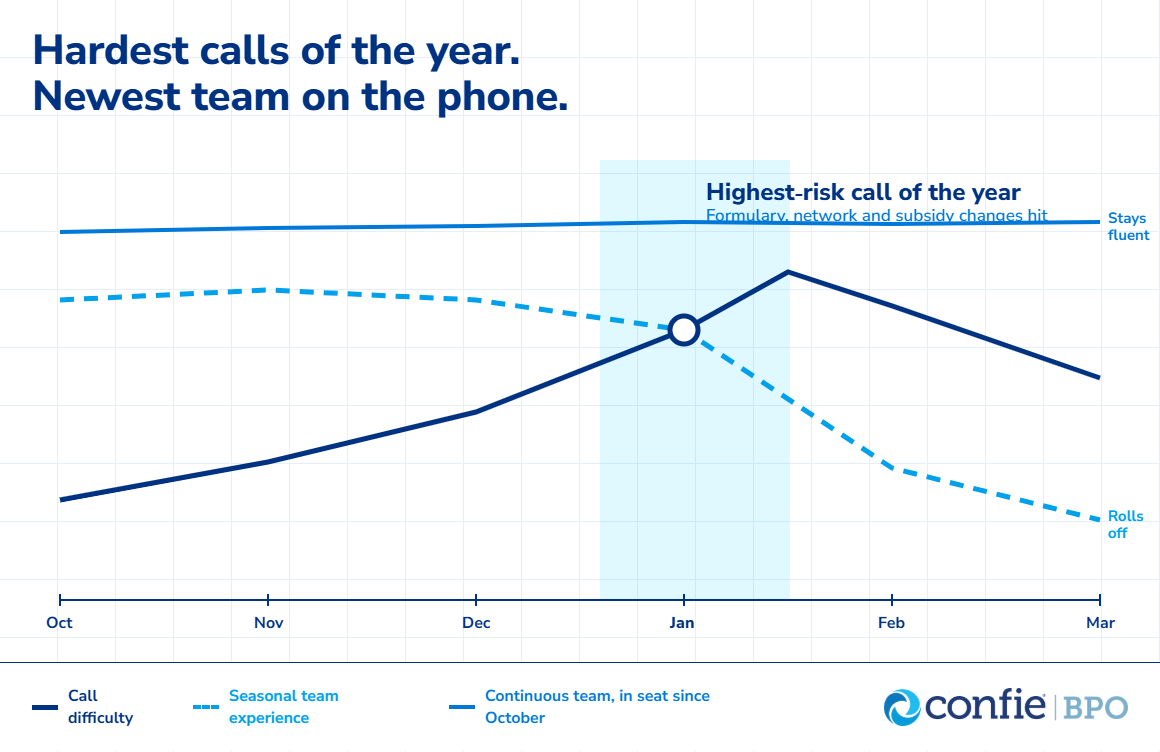
The most expensive month of your plan year is January, and most plans staff it with the least experienced team they will field all season. That mismatch is where retention quietly leaks away.
By January, the seasonal hires brought on for the October enrollment rush are thinning out, just as the hardest calls of the year arrive. Members can switch, benefits have changed, and the conversations are emotional. The team handling them is often the newest.
This post explains why the first quarter is the highest-risk window for retention, what a one-point difference in retention is worth, and why continuity is the single biggest lever a plan controls.
Key Takeaways
- January is the most expensive month of the plan year, yet most plans staff it with their least experienced team, just as the hardest retention calls come in.
- The Medicare Advantage OEP (January 1 to March 31) and the close of ACA open enrollment in mid-January make the first quarter the broadest window to lose a member.
- A one-point improvement in first-quarter retention is material to revenue. On a 50,000-member book, one point is 500 members and a seven-figure annual difference.
- Continuity is the single biggest lever a plan has. The team that enrolled a member in October is most likely to retain them in February.
- CAHPS surveys reach members in March, so first-quarter call quality also sets next year’s Star Ratings. Protecting retention and the rating are the same job.
- A seasonal surge model is weakest exactly when the work is hardest, because continuity is the one thing it is built to discard.
Why January Is the Highest-Risk Month
For Medicare Advantage plans, the Open Enrollment Period runs from January 1 to March 31, and members enrolled in a Medicare Advantage plan can make a one-time switch during that period (Centers for Medicare & Medicaid Services, 2026). The window to lose a member is wide open.
ACA plans face the same pressure on a different calendar. For coverage, open enrollment ran into mid-January in most states (KFF, 2025), and the ensuing period brings a surge of benefit questions and subsidy confusion.
Layer on the new plan year reality. Formularies change, networks shift, and members call, confused or angry, about a benefit they counted on. Every one of those calls is a retention moment.
The Retention Math
Retention is not a soft metric. It maps directly to revenue because every retained member contributes per-member-per-month value for the rest of the plan year and beyond.
Across a large book, a one-point improvement in first-quarter retention is a material revenue difference. Plans that treat January as a revenue-protection window, not just a service window, are the ones that hold their numbers.
The inverse is also true. Members lost in the first quarter are the most expensive kind of loss because they were already enrolled and acquired, and they walked out the door over a conversation that could have gone differently.
The Highest-Risk Call of the Year
Picture the call. It is the second week of January. A member has just learned that their longtime cardiologist is out of network, that a medication they rely on has moved to a different tier, or that their subsidy has changed.
They are frustrated and can leave. Whether they stay often hinges on the next few minutes: whether the professional understands the issue, handles it with empathy, and resolves it on the first call.
That is not a call you want routed to someone who started two weeks ago and is still learning your plan. Members rarely give a plan a second chance to handle that moment well. The decision to stay or leave often forms during the first interaction, which is why the quality of the January call carries so much weight in the March retention numbers.
Why Continuity Is the Lever
The team most likely to retain a member in February is the one that enrolled them in October. They know the plan, may know the member’s history, and are not starting the relationship cold at its most fragile moment.
A continuous, dedicated team that stays in the seat from October through March keeps that context intact. The seasonal model discards it every year and rebuilds from zero, right before the retention surge.
What a Seasonal Vendor Cannot Do
This is the gap that a seasonal staffing model, or a vendor that runs one, cannot close. A surge force assembled for October is, by design, dissolving in January, which means the agents on the phone for the hardest retention calls of the year are the newest, the least plan-fluent, and the most likely to be working out a notice period. A general-purpose outsourcer meets the January number the same way it met the October one, by flexing in temporary, often unlicensed agents who do not know your formulary, your network, or the member they are trying to keep.
Offshore distance adds a time-zone gap and, for Spanish-speaking members, a cultural one. Whether the calls are understood determines whether the member stays. None of this is a knock on the people. It is the math of a model that treats the most fragile month of the year as a staffing-cost problem rather than a revenue-protection one. Continuity is the one variable the model cannot supply, because continuity is what it is built to discard.
How This Shows Up in Your Rating
Retention and the rating move together. CAHPS surveys reach members in March, so the first-quarter experience that drives switching also drives the survey scores that set next year’s rating (Press Ganey, 2026). Member experience is an increasingly large share of that rating as administrative measures are removed (Press Ganey, 2026).
Disenrollment and complaints, both shaped by the January call, feed the same score. Protecting retention and the rating are the same operational job.
The Q1 Metrics That Predict March
For the leader who runs the floor, the first quarter has its own dashboard that forecasts the March retention number weeks in advance. Save rate is the headline: the share of at-risk members who stay after a switching or complaint call. But the leading indicators sit upstream.
First-call resolution on formulary and network questions determines how many members leave the call satisfied rather than shopping. Average speed of answer and abandonment determine how many frustrated members ever reach a professional, because a member who cannot get through in January does not wait; they switch. Repeat-contact rate flags issues that were not resolved the first time and are now compounding. Watch those four through January and February, and the March disenrollment report will hold no surprises. A team that resets every fall cannot hold these metrics, because it is relearning the plan at the exact moment it needs to be fluent.
A Look at the Math in Practice
Imagine a plan with a sizable membership base entering the first quarter. A handful of percentage points of disenrollment, spread across that book, represents a meaningful number of members and the revenue each carries for the rest of the year.
Now imagine even a fraction of those departures trace back to a single avoidable cause: a frustrating, unresolved call about a formulary or network change. The retention lost on those calls is not a footnote to service. It is a line on the revenue forecast.
This is why leading plans reframe the first quarter from a cost-containment window to a revenue-protection window. The team handling those calls is defending the book the plan spent all of AEP to build.
Retention as Revenue Protection
For a chief operating officer, the first quarter is when the cost of the call center and the value it protects are farthest apart and most often misjudged. Put the numbers together. On a book of 50,000 members, a single point of first-quarter disenrollment is 500 members, and at a typical Medicare Advantage per-member-per-month value, that represents a seven-figure annual revenue loss, much of it avoidable. The save calls that prevent those departures are not where a budget should look for savings. They are where a plan defends the book it spent all of AEP and its entire acquisition budget to build.
The reframe is straightforward. A March loss cost the plan its full acquisition investment and the remaining year’s premium and rebate value, despite a conversation that a fluent, continuous team would likely have won. Measured that way, the retention operation is one of the highest-return line items in the plan, not a discretionary one. The vendors that look cheapest on a per-hour basis are often the most expensive once first-quarter churn is factored in.
The First Quarter Is Also an Onboarding Quarter
Retention in the first quarter is not only about saving members who want to leave. It is also about avoiding the reasons in the first place. Members who enrolled in October and November are brand new to the plan year in January: new ID cards, new formularies, first claims, first prior authorizations. Each of those is a moment that either builds trust or seeds the frustration that becomes a February save call.
A continuous team that handled enrollment is positioned to handle onboarding, and a well-onboarded member rarely becomes a retention risk. The cheapest save call is the one that never has to happen, because the member’s first weeks on the plan went smoothly. That is why first-quarter staffing must cover both onboarding and retention with the same team, rather than treating them as separate problems handed to temporary hires.
What Good First-Quarter Staffing Looks Like
A plan prepared for the first quarter does not scramble in December. It has a dedicated team already in place, already fluent in the plan’s formulary and network changes, ready for the switching conversations before they arrive.
- Trained before the changes took effect. Staff already know the new plan-year formulary and network changes, so they are not learning them during live calls.
- Continuity from enrollment. The same professionals who enrolled members are present for the retention conversations.
- Empowered to resolve. The authority and tools to solve the issue on the first call, rather than transferring or escalating.
- Culturally fluent. Bicultural professionals embedded in the emotional save calls that decide whether a member stays.
None of this is achievable with a class hired in December. It is the product of a decision made the previous summer, with the team activated about 30 days before the season opens, so it is fluent and in-seat before the first switching call.
The ACA Retention Window Runs on Its Own Clock
Medicare gets most of the attention, but ACA plans face a parallel first-quarter challenge. After open enrollment closes in mid-January in most states (KFF, 2025), the period of effectuation and the early weeks of coverage trigger a wave of benefit questions, subsidy confusion, and plan switching.
The emotional center of those calls is the same as Medicare: a member who is confused or frustrated about the coverage they are counting on, deciding in real time whether this plan is worth keeping.
A team built only for Medicare OEP misses this. A team built for the full open enrollment arc serves both books through their overlapping retention windows with the same continuous staff, rather than standing up and tearing down two separate operations. For plans that carry both Medicare and ACA membership, that shared continuity is not just an efficiency. It is a consistency advantage because the same trained professionals apply the same standard of service across both books at the moment each is most at risk.
What the Member Remembers
For the leader who owns the member experience, the first quarter is where the relationship is decided for the year. A member does not weigh a plan by its average performance. They weigh it by the call that mattered, the one where they were frightened about a medication or angry about a lost doctor, and by whether the plan met that moment. Net Promoter and survey scores are, in large part, the memory of those few calls. Handle them with a fluent, empathetic professional who resolves the issue, and the member becomes an advocate. Handle them with a stranger reading a script, and the member becomes a detractor who leaves at the next open enrollment and tells others why. The first quarter is short, but it casts the longest shadow over the years’ experience scores.
The Bicultural Dimension of the Save Call
On the hardest first-quarter calls, language alone is not enough. A member frightened by a medication change or grieving a lost doctor is making an emotional decision, and for a member served in a second language, whether the professional understands the cultural context, not just the words, often decides whether they stay. This is why the retention seat is also, for many plans, a bicultural seat. The save call is where being genuinely understood and merely being answered produce different outcomes, and a continuous team with embedded cultural fluency is positioned to win it, whereas a transferred, language-only queue is not.
Building the First-Quarter Team
The team that wins the first quarter is built before the first quarter, not during it. That means recruiting and certifying professionals who will still be in seat in February, training them on the new plan year’s formulary and network changes before those changes go live, and giving them the authority and tools to resolve an issue on the first call rather than escalate it. It also means staffing the retention and onboarding work with the same people who handled enrollment, so the member’s history travels with them. A plan that tries to assemble this in December is already behind, because a class hired then is still ramping when the OEP switching calls arrive. The practical move is to commit about 30 days before the season opens, the length of a standard activation runway, so the team is fluent and ready when the first hard call lands.
The contrast with the surge model is stark. A seasonal force is least capable precisely when the work is hardest, while a continuous team is most capable because it has been carrying the same book since October. The difference is not effort. It is who is on the phone when the member decides.
Two Books, One Continuous Team
For plans that carry both a Medicare and an ACA book, the first quarter is doubly demanding: OEP switching on the Medicare side and effectuation questions on the ACA side arrive in the same weeks. Standing up two separate seasonal operations doubles the cost and halves institutional knowledge. A single, continuous team trained on both books carries both retention windows with one fluent staff member, applying the same standard of service to each at the moment it is most at risk. The continuity that protects the Medicare book also protects the ACA book.
The December Pivot
The continuous team has one advantage the seasonal model cannot: it uses December to prepare for January. While a surge force is shedding staff and the survivors are coasting toward the holidays, a dedicated team is studying the new plan year’s formulary and network changes, the exact issues that will drive the hardest calls six weeks later. By the time a member calls in the second week of January, frightened that a drug moved tiers, the professional has already seen the change, knows the alternatives, and can resolve the call rather than researching it live. That preparation is invisible on a staffing spreadsheet but decisive on the phone. It is the difference between a team that meets January ready and one that meets it learning.
Three Recommendations for First-Quarter Staffing
- Commit to a continuous, dedicated team by midsummer and activate it about 30 days before the season opens, so it is fluent in the new plan year’s formulary and network changes before the first January switching call occurs.
- Staff retention and onboarding with the same professionals who handled enrollment, and embed bicultural agents in the retention seat so the member’s history and cultural fluency carry through the highest-risk save calls.
- Track four leading indicators through January and February (save rate, first-call resolution for formulary and network questions, average speed of answer and abandonment, and repeat-contact rate) to predict and protect the March disenrollment number weeks in advance.
Keep the members you spent all of AEP earning.
Watch the On-Demand Session
Our webinar, OEP Retention: The Member Services Strategy That Keeps Members Enrolled, covers the first-quarter retention math, the highest-risk calls, and the continuity model behind them.
A Note on How This Model Is Built
ConfieBPO maintains continuous, bicultural member service teams in seats throughout the full season, an approach refined for insurance and regulated industries since 1998. The point is the principle: the team that wins January has been on the phones since October.
Frequently Asked Questions
- Why is January the riskiest month for retention?
January is the riskiest month because the Medicare Advantage OEP runs from January 1 to March 31, allowing members to switch plans (Centers for Medicare & Medicaid Services, 2026). New plan-year formulary and network changes coincide, triggering emotional, high-stakes calls precisely when many plans field their least experienced seasonal team.
- What is a one-point retention improvement worth?
A one-point improvement in retention is a material revenue gain because every retained member carries per-member-per-month value across the rest of the plan year and beyond. On a 50,000-member book, a single point is 500 members, and at a typical Medicare Advantage per-member-per-month value, this translates to a seven-figure annual difference.
- Which first-quarter metrics predict the March retention number?
Save rate is the headline metric, but the leading indicators sit upstream: first-call resolution for formulary and network questions, average speed of answer and abandonment, and repeat-contact rate. Watch those four through January and February. If the March disenrollment report holds no surprises, problems surface weeks before they become losses.
- Does first-quarter retention apply to ACA plans?
Yes. ACA open enrollment runs through mid-January in most states (KFF, 2025), and the following effectuation period brings a surge of benefit questions, subsidy confusion, and plan switching. The emotional center of those calls mirrors that of Medicare, so the same continuity and cultural fluency protect both books during their overlapping windows.
- How does first-quarter service affect Star Ratings?
First-quarter service directly shapes the rating because CAHPS surveys reach members in March. The experience that drives switching also drives the survey scores that set next year’s Stars (Press Ganey, 2026). As administrative measures are removed, member experience accounts for a growing share of the rating, making the January call a rating event.
- Why does continuity matter so much for retention?
Continuity matters because the team that enrolled a member in October already knows the plan and often the member’s history, which is exactly what a fragile February retention call requires. A seasonal model discards that context each year and rebuilds from zero just before the retention surge, leaving the newest agents with the hardest calls.
- When should a plan prepare its first-quarter retention staffing?
A plan should be committed to before the season starts, not in December. With a standard 30-day activation runway, the team should be committed and activated about a month before the window opens (Centers for Medicare & Medicaid Services, 2026), so it is fluent in the new plan year and in seat before the first switching call.
- Why not just add temporary staff for January?
Temporary staff added in December are still ramping up when the hardest retention calls arrive, and they lack the plan-specific formulary and network knowledge those calls require. A surge force is least capable exactly when the work is hardest. Continuity from October is what protects retention because the model cannot provide fluency on demand.
- What does a continuous team do in December?
A continuous team uses December to prepare. While a seasonal force sheds staff and coasts into the holidays, a dedicated team studies the new plan year’s formulary and network changes, the exact issues that will drive January’s hardest calls. By the time a member calls, frightened that a drug has moved tiers, the professional can resolve it rather than research it live.
References
Press Ganey. (2026). Are you ready? CMS just ignited the biggest Stars shake-up in a decade. https://www.pressganey.com/resources/blog/cms-stars-shake-up/
Centers for Medicare & Medicaid Services. (2026). Open enrollment. Medicare. https://www.medicare.gov/health-drug-plans/open-enrollment
KFF. (2025). When can I enroll in Marketplace health plan coverage? https://www.kff.org/faqs/faqs-health-insurance-marketplace-and-the-aca/marketplace-enrollment-periods/when-can-i-enroll-in-marketplace-health-plan-coverage/